Accessing invisible information to understand, qualify, and secure complex systems: NEUTRON IMAGING
Neutron imaging makes it possible to observe the interior of complex systems without destroying them. GEMESIS develops industrial solutions to make this technology usable, modular, and decision-oriented.
Learn moreNeutron imaging is an advanced imaging technology that enables observation of the interior of complex systems without destruction. It provides access to information that is unreachable with conventional methods when challenges involve multi-material assemblies, internal phenomena, or defects invisible at the surface. Unlike purely destructive or indirect approaches, neutron imaging makes it possible to observe the real operation of a system in its assembled state and to deliver a detailed understanding of critical internal phenomena affecting performance, safety, and reliability.
WHY NEUTRON IMAGING?
Neutron imaging provides access to internal information invisible to conventional methods, enabling the understanding, qualification, and securing of complex systems without destruction.
Observe the interior without disassembly
Neutron imaging enables the analysis of closed systems in their assembled state, without disassembly or alteration, even when the phenomena of interest are deeply internal.
Access contrasts invisible to X-rays
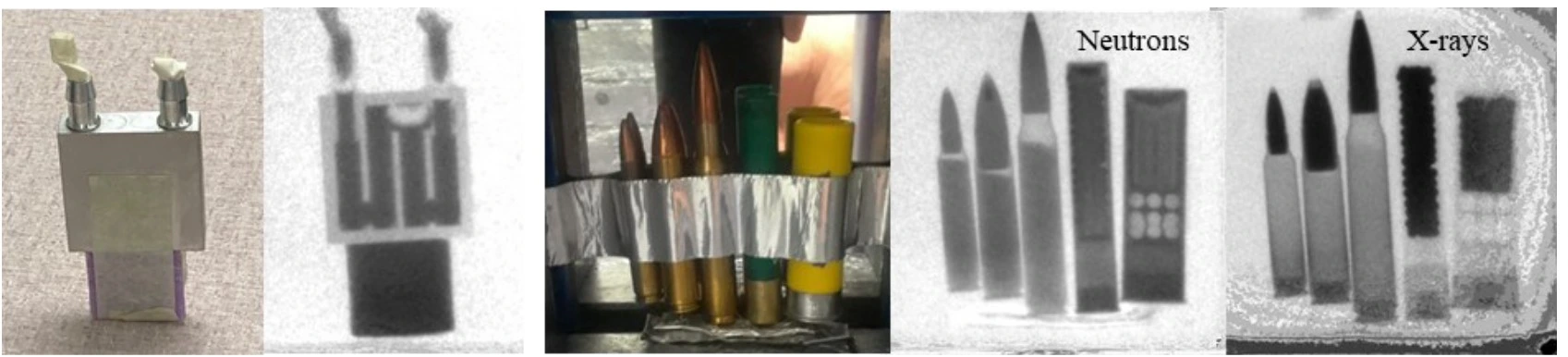
Unlike X-rays, neutrons interact with atomic nuclei, offering unique and complementary contrasts, particularly well suited to hydrogen-rich materials, fluids, and polymers.
Understand real phenomena under operating conditions
Neutron imaging makes it possible to observe internal distributions of materials or fluids, compare states before and after loading, and identify the mechanisms behind defects or failures.
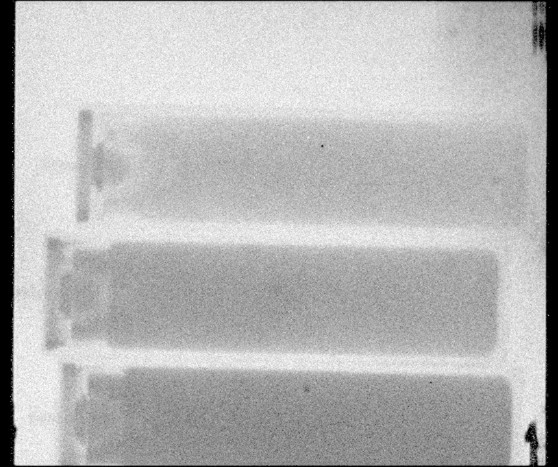
“Hydrogen hydride tank (filled at the bottom, empty at the top)”
Industrial use cases
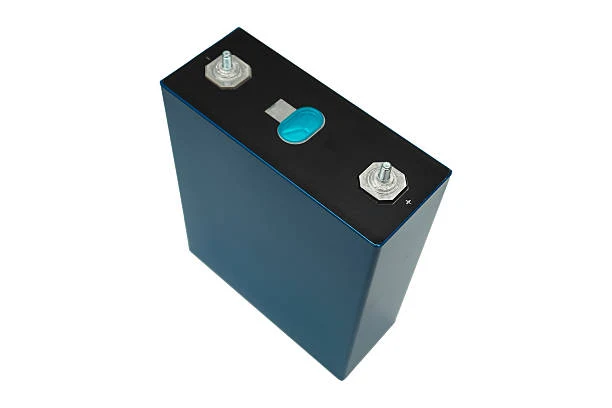
Batteries and energy storage
In the field of batteries, neutron imaging enables the observation of key phenomena at the heart of cells and modules. It is particularly relevant for analyzing electrolyte filling, its internal distribution, and its evolution over time.
It also highlights internal degradation phenomena such as dendrite formation, local heterogeneities, or areas of accelerated aging that are difficult to observe with other techniques. This information is critical for process qualification, batch comparison, failure analysis, and securing industrialization choices.
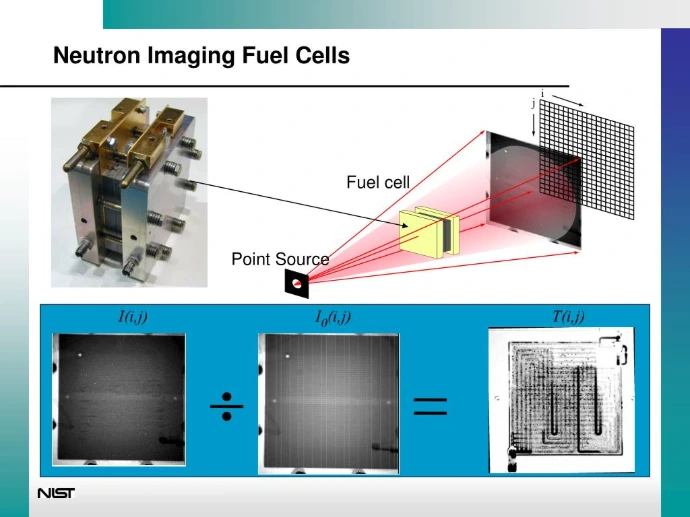
Source: National Institute of Standards and Technology (NIST)
Hydrogen and controlled-atmosphere systems
Neutrons are particularly well suited for studying systems involving hydrogen and light phases. They enable visualization of two-phase phenomena, water distribution, analysis of wet and dry zones, and observation of internal dynamics in confined systems.
These capabilities are essential for understanding the real operation of hydrogen systems, validating components, optimizing architectures, and improving durability and safety.
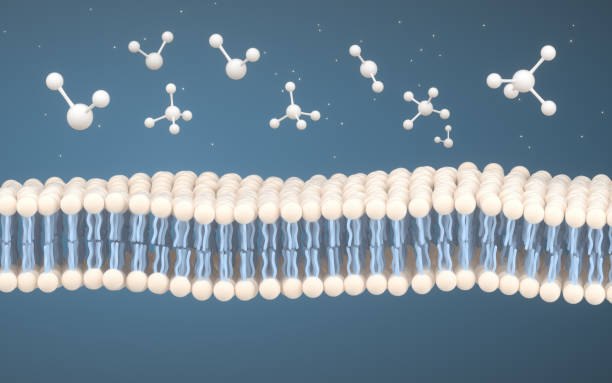
Membrane systems
Neutron imaging opens major perspectives for analyzing systems based on functional membranes. This includes applications such as osmosis, thermal conduction, fuel cells, electrolyzers, and more broadly ion or molecular exchange devices.
It enables observation of fluid distribution within membranes, internal gradients, saturation or drying phenomena, and performance evolution under varying operating conditions. This information is essential for understanding real physical mechanisms, optimizing materials, and ensuring long-term system reliability.
Mechatronic and fluidic components
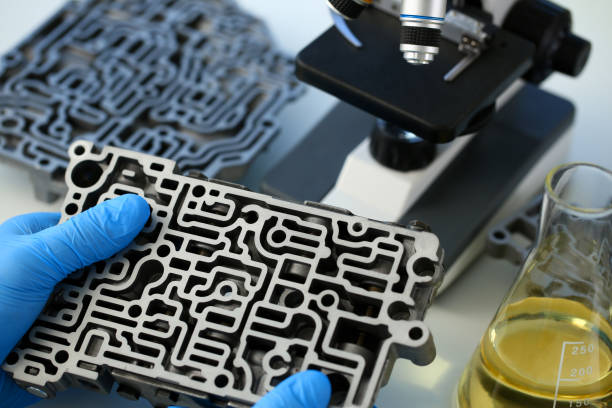
Neutron imaging is also relevant for the non-destructive analysis of complex mechatronic and fluidic components. This includes, for example, cryogenic systems, heat exchangers, blades, and components subject to internal flows or high thermomechanical stresses.
It enables observation of internal material or fluid distributions, detection of assembly defects, internal heterogeneities, or degradation phenomena, without disassembling or altering the component.

Defense and critical energy systems
In the defense sector and dual-use applications, many systems rely on highly integrated energy architectures that are not accessible through conventional methods. This includes systems such as munitions, missiles, and their energy sub-assemblies.
Neutron imaging enables observation of internal elements at the core of these energy systems, where X-rays reach their limits. It allows non-destructive analysis of internal distributions, heterogeneities, or otherwise invisible defects, without modifying the system state.
This capability is decisive for qualification, aging analysis, understanding degradation mechanisms, and reducing industrial and operational risk in systems of high strategic value.
Current market limitations
Despite its recognized potential, neutron imaging remains difficult to access for regular industrial use. The main barriers are limited access to infrastructure, the complexity of test campaigns, radiation-protection constraints, and data exploitation that is often research-oriented rather than decision-driven. These limitations slow the adoption of neutron imaging as an engineering and industrial steering tool.
An integrated approach
X-rays + Neutron Imaging
Leverage the complementarity of both technologies to:
reduce uncertainty zones
accelerate result interpretation
strengthen the analysis of complex systems
A modular and deployable solution
Designed for industry
A containerized, mobile, and scalable solution designed to:
adapt to industrial constraints
reduce logistical lead times
bring testing closer to real-world challenges
Our approach
Making neutron imaging operational and industrial. A long-term vision designed for real use cases and field constraints.
A reference partnership with Exosens
Designed for industry
We rely on the expertise of Exosens, a major player in advanced detection technologies, to guarantee:
system performance
industrial robustness
long-term sustainability of solutions
A project supported by France 2030, the European Union, and the Auvergne-Rhône-Alpes Region
The development of this approach benefits from the support of France 2030 and the Auvergne-Rhône-Alpes Region through funding dedicated to the industrialization of advanced technologies. These strategic supports accelerate the design of our solutions, structure key technological building blocks, and concretely demonstrate the value of this approach through real industrial use cases. We are in good company.


Do you have a complex system to qualify?
Whether for R&D, qualification, safety, or industrialization challenges, our teams support you in implementing advanced testing solutions integrating neutron imaging.
