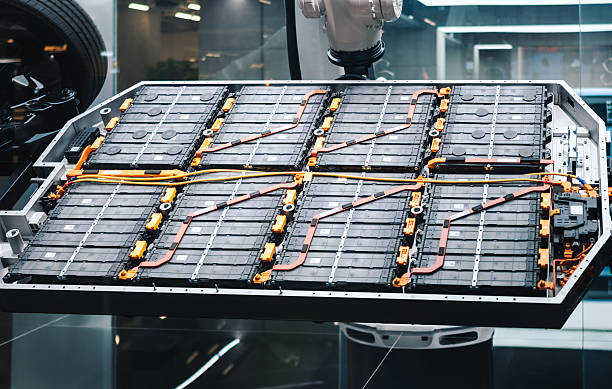
Battery and Thermal Propagation
Measure the Energy Transferred During a Thermal Event
Context
Temperature measurements alone do not always provide enough information to understand how energy propagates between cells or through the materials that make up a battery pack.
Integrating heat flux sensors makes it possible to directly quantify the power received by a cell, thermal barrier or structural component.
Applications
- Thermal barriers
- Thermal propagation
- Heat transfer
- Protective materials
- Heat flux measurement on surfaces
- Comparison of cooling solutions
- Cold plate measurements
- Thermal model validation
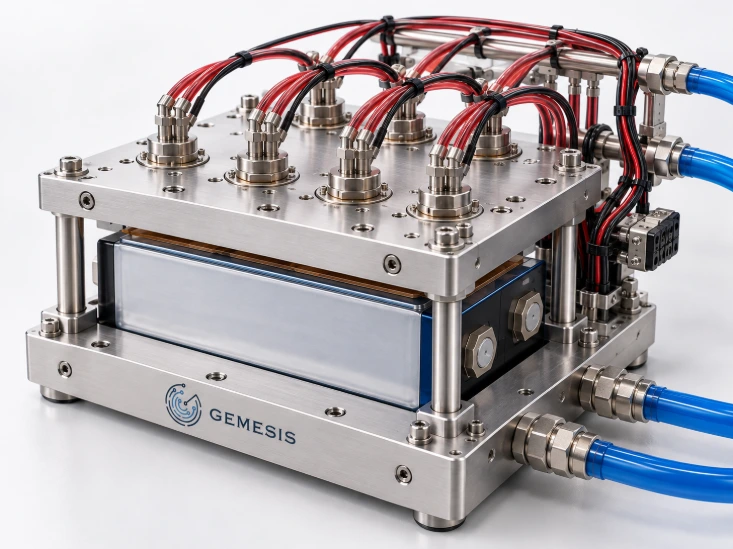
Custom Instrumented Tooling for Battery Cells
Temperature alone does not always provide enough information to understand the thermo-mechanical behavior of a battery cell.
During charging, discharging, fast cycling or abuse testing, a cell can generate localized heat fluxes, develop hot spots, deform or swell, and progressively modify the contact pressure with its surroundings.
GEMESIS develops custom instrumented tooling to characterize these phenomena simultaneously as close to the cell as possible.
Our solutions can be adapted to the main cell formats:
Pouch · Prismatic · Cylindrical 18650 · 21700 · 4680 · Custom formats
Mapping Heat Flux Directly Around the Cell
GEMESIS can integrate heat flux sensors into the plates, supports or mechanical interfaces of the tooling.
The objective is to move beyond a single-point temperature measurement and determine where and at what intensity the cell exchanges thermal energy with its surroundings.
A sensor array can therefore be used to reconstruct a spatial heat flux map across one face of a cell or around a cylindrical cell.
This approach can be used to identify:
- Areas with the highest heat generation
- The appearance and movement of hot spots
- Cooling asymmetries
- The influence of cell design
- The effectiveness of a thermal interface or cooling system
- Changes in thermal behavior during aging
- Transient phenomena during high-current charge or discharge
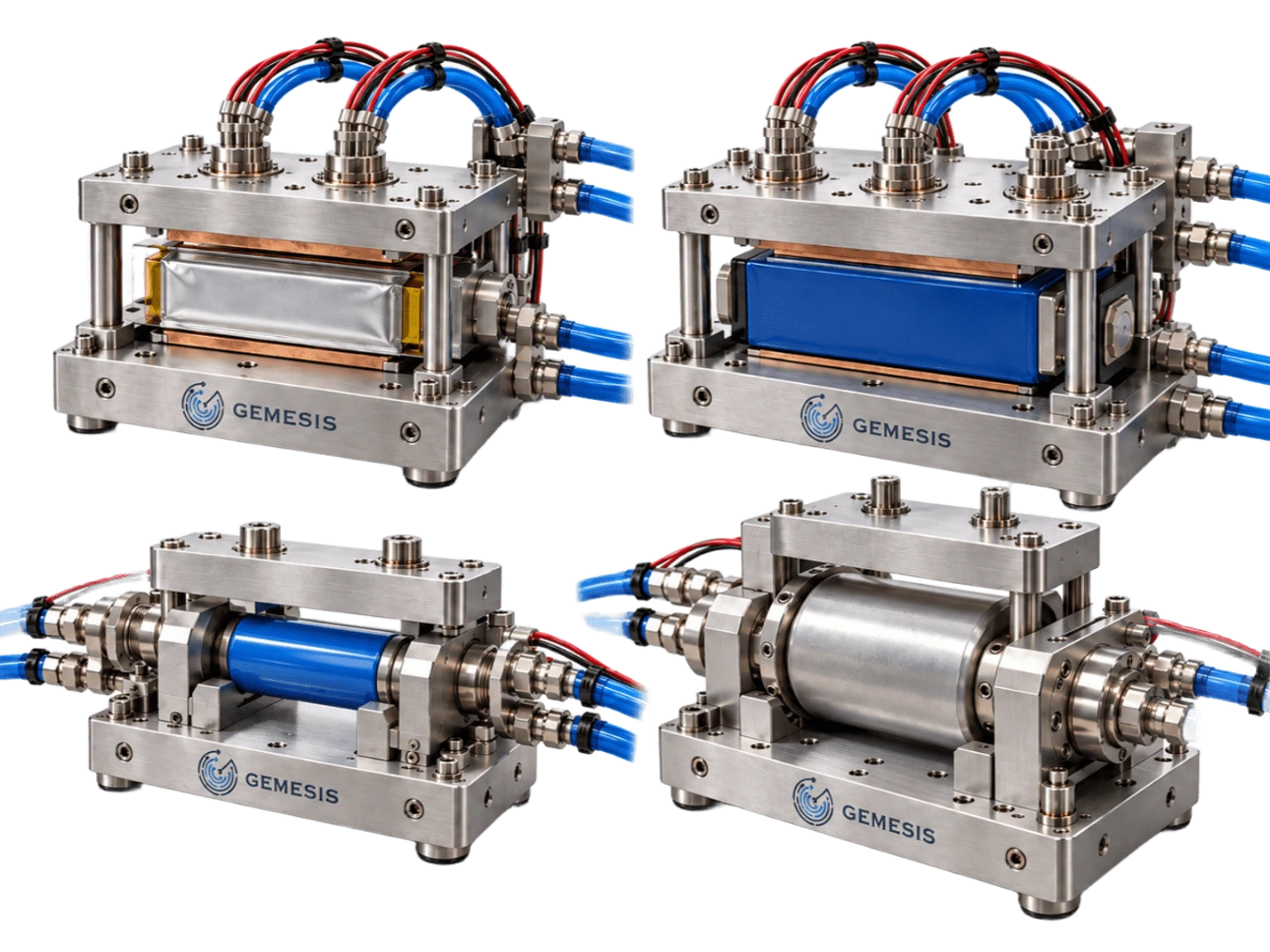
Combining Heat Flux and Pressure Mapping
GEMESIS can go further by combining thermal measurements with pressure or contact force mapping.
This is particularly relevant for pouch and prismatic cells, whose dimensions and mechanical forces can change during cycling.
The tooling can simultaneously monitor:
Heat flux + temperature + pressure + compression force + electrical data
This makes it possible to investigate correlations between local changes in pressure and changes in the thermal behavior of the cell.
For example, an area with poor contact pressure may also exhibit different thermal resistance. Conversely, local cell swelling can modify contact with a cooling plate and therefore affect how heat is removed.
Why Use Dedicated Instrumented Tooling?
In a conventional setup, instrumentation is often added around the cell after the mechanical design has been completed. This can create contact conditions that are difficult to reproduce and make test results harder to compare.
Our approach is to integrate the measurement system directly into the tooling.
The geometry, thermal interfaces, compression, sensor positioning and cable or cooling circuit routing are designed together.
This provides better control of:
- Positioning repeatability
- Pressure applied to the cell
- Thermal contact conditions
- Exact location of measurement points
- Reproducibility between cells
- Integration into a climate chamber or battery cycling test bench
Tooling Adapted to Each Cell Format
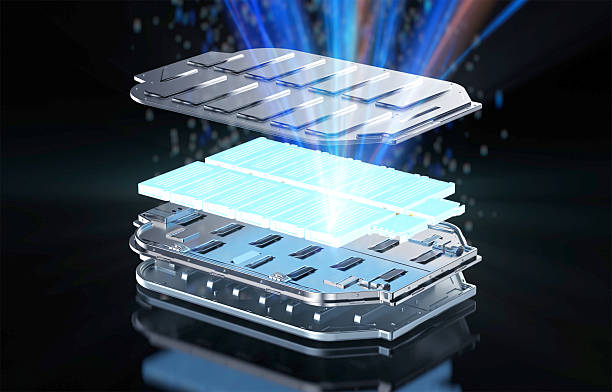
Pouch Cell
Matrix measurement across the large cell faces while precisely controlling compression.
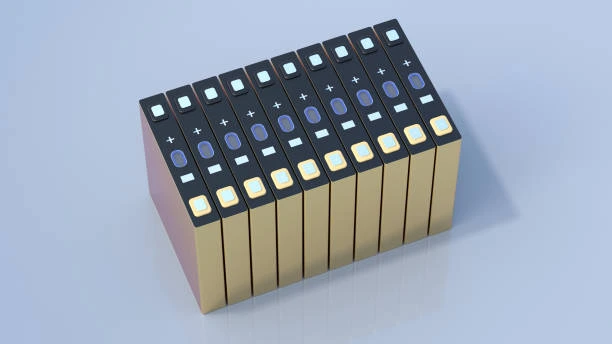
Prismatic Cell
Multiple measurement points can be distributed across one or more faces to obtain both thermal and mechanical mapping.
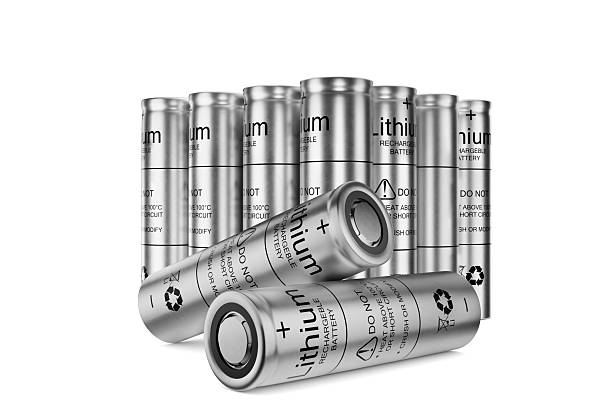
Cylindrical Cell
18650 - 21700 - 4680
Sensors can be integrated into supports that follow the cell geometry to study heat flux distribution around its casing.
Interchangeable interfaces make it possible to use the same test bench with different cell geometries.
From Instrumented Tooling to a Complete Test Bench
GEMESIS can supply the instrumented tooling alone or manage the complete measurement chain:
Mechanical tooling → Sensors → Signal conditioning → Data acquisition → Battery cycling → Climate chamber → Automation → Data synchronization → Visualization and analysis
The objective is to turn an instrumented cell into a true thermo-mechanical analysis tool, making it possible to observe how heat, mechanical forces and electrical performance evolve together throughout the test.
GEMESIS develops each tooling solution according to the cell, test protocol and physical phenomenon you need to understand.
GEMESIS Integration
GEMESIS synchronizes heat flux measurements with temperature, cell voltage, pack current, electrical power, pressure and video or thermal imaging data.
This architecture makes it possible to reconstruct the complete energy timeline of a thermal event.
This is notably the approach we are developing with our GMS FT 001 Battery Thermal Protection Test Bench.