Battery Thermal Protection Test Benches
Thermal propagation, flame exposure and particle projection testing
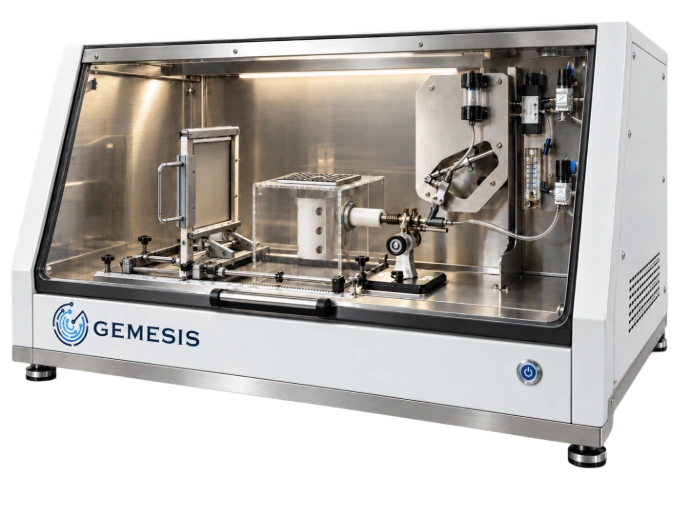
GEMESIS, in collaboration with Metal Machines and Nextherm Sensing, offers the study and development of custom industrial test benches for characterizing thermal protection materials used in batteries.
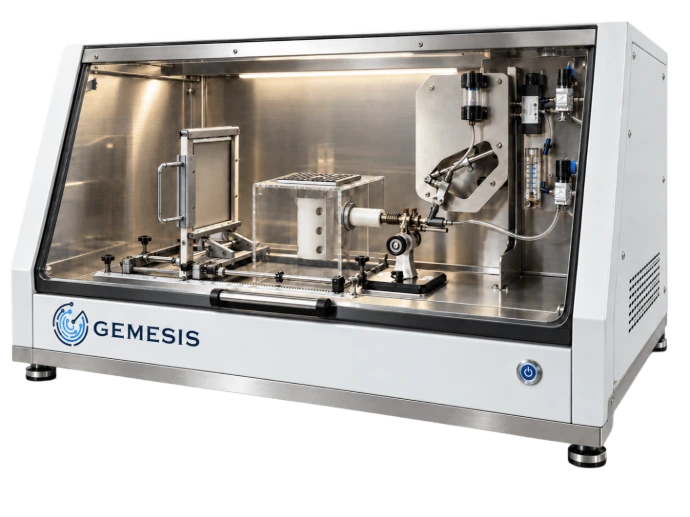
These systems are designed to reproduce severe thermal and mechanical conditions in the laboratory, representative of certain phenomena that occur during thermal runaway.
Our approach combines three complementary areas of expertise: flame generation and particle projection, test machine integration and automation, and advanced heat flux measurement.
Technology Built on Practical Experience
The proposed developments build in particular on the experience gained by Metal Machines, which designed an initial Torch and Grit (TaG) test bench delivered to CREPIM in February 2025.
This equipment contributed to the development work associated with Revisions A and B of the Stellantis LP.7M119 protocol.
Operating this equipment helped identify the challenges encountered during these tests, including the destructive effects of projected abrasive particles, high thermal loads, and the need for robust components.
This feedback provides a technical foundation for developing new industrial machines designed to withstand particularly aggressive environments while making operation and maintenance easier.
Three Complementary Areas of Expertise
Metal Machines: Flame Generation and Particle Projection
Metal Machines contributes its expertise in the design of Torch and Grit test benches, high-temperature flame generation systems, and particle projection systems.
Its experience in developing and operating this equipment helps identify necessary improvements and support the evolution of test protocols.
GEMESIS: Industrial Design, Integration and Automation
GEMESIS brings its expertise in developing test benches and special-purpose machines. Our capabilities include:
- Mechanical and electrical design and integration
- Instrumentation sizing and integration
- Control system and automation development
- Data acquisition and synchronization
- Test supervision and result traceability
- Integration of safety systems
- Equipment ergonomics, robustness and maintainability
Test benches can be adapted to the specific requirements of laboratories, research centers and industrial facilities.
Nextherm Sensing: Advanced Heat Flux Measurement
Integrating Nextherm Sensing heat flux measurement technologies offers an additional measurement option alongside conventional thermocouples.
Depending on the test protocol and operating conditions, these sensors can measure the incident heat flux applied to a reference area.
This instrumentation aims to improve understanding of thermal loads, facilitate comparisons between tests, and provide additional data for material development.
Sensor selection, positioning and protection must be assessed according to the temperatures and abrasive conditions involved.



Potential Features
Depending on requirements and the selected test protocols, future test systems may incorporate the following features:
Thermal exposure
High-temperature flame generation and control of exposure conditions.
Particle projection
Generation and control of abrasive loading conditions.
Specimen positioning
Fixtures and configurations adapted to the materials being tested.
Instrumentation
Thermocouples and heat flux sensors.
Automation
Control of flame and particle projection sequences, as well as test phases.
Data acquisition
Synchronized measurements, visualization and data recording.
Safety
Integration of suitable protective systems and monitoring devices.
Industrial robustness
Material selection, protection of exposed components, and ease of maintenance.
Solutions Adapted to Test Protocols
These test systems can be developed to meet characterization requirements associated with various protocols, including:
Stellantis LP.7M119
A protocol for characterizing thermal protection materials used in battery applications, involving thermal exposure and particle projection.
UL 2596-1, Torch and Grit (TaG)
A test method designed to evaluate the behavior of battery materials under thermal and abrasive mechanical loading.
The evolution of these protocols requires particular attention to flame generation, particle projection system characteristics and calibration conditions.
Performance and compliance with applicable requirements must be verified during the development and validation of each piece of equipment.
Applications
These machines may address the needs of a range of organizations, including:
Manufacturers of battery cells, modules and packs
Manufacturers of composites, insulation and thermal barriers
Developers of thermal protection materials
Automotive suppliers
Research laboratories and test centers
Stationary energy storage companies
These systems can support research and development, material comparison, the development of new thermal protection solutions, and the preparation of qualification test campaigns.
Towards More Instrumented and Robust Test Systems
Our goal is to build on experience gained from Torch and Grit testing to develop industrial machines that combine mechanical robustness, controlled test conditions and advanced instrumentation.
By bringing together the expertise of Metal Machines, GEMESIS and Nextherm Sensing, we aim to provide industrial customers with solutions tailored to battery safety and thermal protection challenges.
Developing a Thermal Material Characterization Test?
Let’s discuss your requirements.
GEMESIS and its partners can assess the feasibility of a dedicated test bench, including its architecture, instrumentation and automation options, tailored to your test protocols.